Age Verification Software: How Automated ID Scanning Keeps Businesses Compliant
Feb 28 2026
Age verification has become one of the most closely scrutinized compliance requirements across regulated industries. Governments and regulatory bodies in markets across North America, Europe, and Asia-Pacific have significantly tightened their expectations for how businesses confirm that customers accessing age-restricted products and services are legally permitted to do so. The penalties for non-compliance — ranging from substantial fines and license suspension to criminal liability for individual operators — have grown proportionally with the expansion of digital commerce into age-restricted categories.
The core challenge is structural. Traditional age verification methods — manual document inspection by staff, self-declaration checkboxes, or date-of-birth entry fields — are demonstrably inadequate under regulatory scrutiny. Manual inspection is inconsistent, subject to social pressure, and impossible to audit at scale. Self-declaration has no evidentiary value whatsoever. As regulators increasingly demand documented, auditable proof that age verification has been performed accurately, businesses relying on these approaches face mounting exposure that grows with every transaction processed.
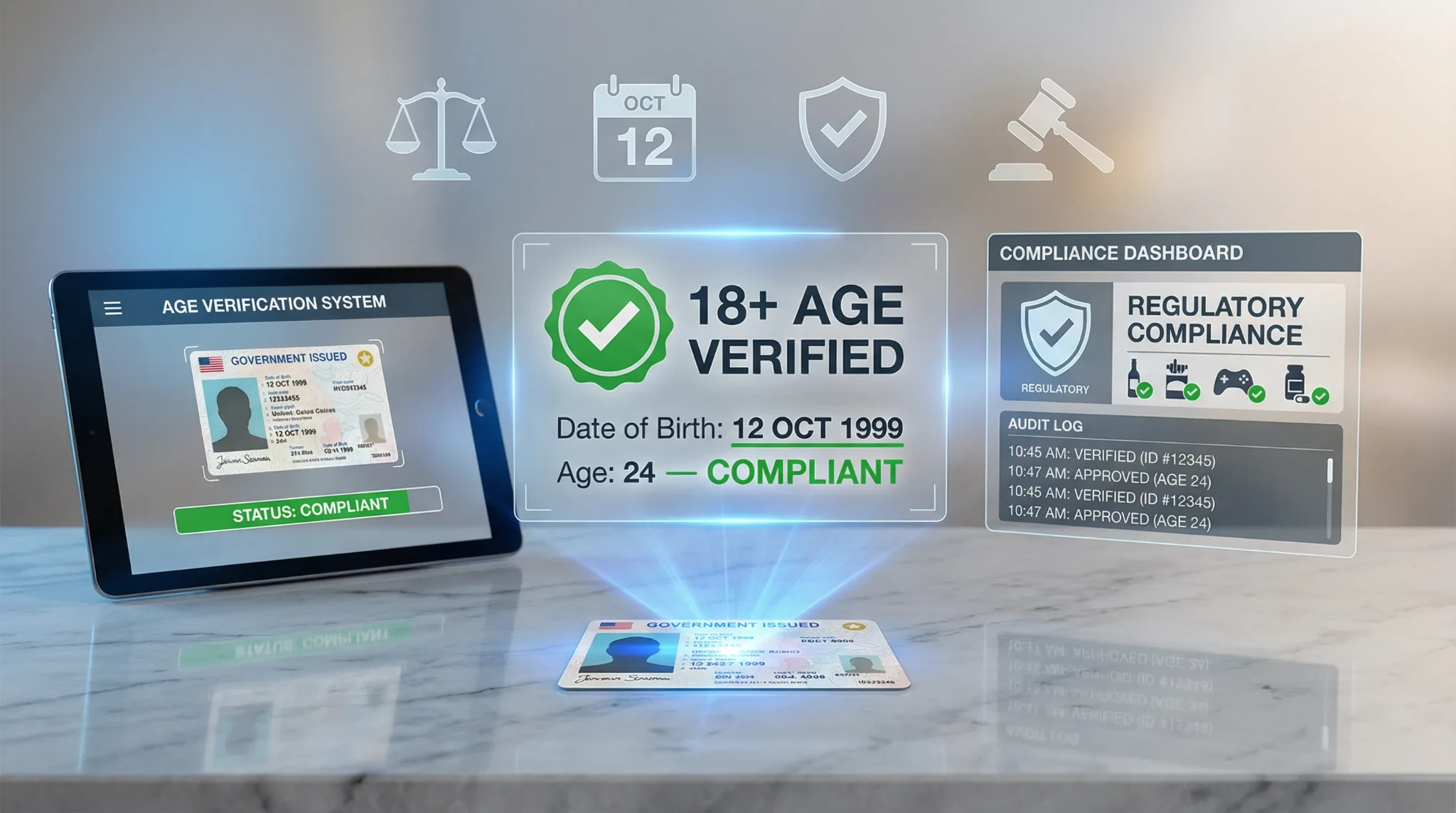
Here's when automated age verification technology enters the game. Modern solutions use OCR (optical character recognition) combined with document authentication and biometric matching to extract and validate date-of-birth data from government-issued identity documents automatically, generating the structured audit trail that compliance frameworks require. Given this capability, understanding how age verification software works, where it applies, and what a reliable implementation looks like is essential for any business operating in an age-restricted market.
What Is Age Verification Software?
Age verification software is a technology solution that automates the process of confirming that a customer meets the minimum age requirement for a product, service, or platform — by validating their identity against a government-issued document rather than relying on self-reported data. It combines document scanning, data extraction, date-of-birth calculation, and in many implementations, biometric liveness detection to deliver a verification outcome that is both accurate and auditable.
The process is designed to work as follows: the user submits an image of their identity document — a passport, driver's license, or national ID card — via a mobile camera or web upload. The software extracts the date of birth using OCR and machine-readable zone (MRZ) parsing, calculates the user's current age, compares it against the configured minimum age threshold, and returns a pass or fail outcome — along with a timestamped compliance record. In other words, the entire verification workflow is automated, consistent, and generates documentary evidence that the check was performed correctly.
What is also important here is that age verification software is not a single monolithic product. Solutions may be delivered as mobile SDKs, web APIs, or cloud-based verification platforms, and they vary considerably in the depth of document authentication, biometric capability, and compliance reporting they provide. That's why evaluating the feature set carefully — not just the surface-level verification outcome — is essential for businesses with genuine regulatory exposure.
When Does It Make Sense to Deploy Age Verification Software?
Automated age verification delivers compliance value across a broad and expanding range of industries. Regulatory requirements for documented age checks are increasingly common in contexts including, but not limited to:
- Online alcohol and tobacco retail: E-commerce platforms selling age-restricted products are subject to increasingly stringent verification requirements in the EU, UK, US, and Australia.
- Online gaming and gambling: Gaming license conditions in virtually every regulated jurisdiction mandate identity and age verification before account activation and real-money play.
- Cannabis dispensaries and delivery services: Both in-store and delivery operations in legalized markets require documented age confirmation at the point of sale or handoff
- Adult content platforms: Regulatory frameworks in the UK, EU, and other jurisdictions are mandating robust age verification for platforms hosting adult content, with significant penalties for non-compliance.
- Vaping and e-cigarette retail: Online and in-store sales of nicotine products are subject to age restrictions that are increasingly enforced with documentation requirements.
- Pharmaceutical and prescription services: Online pharmacy and telehealth platforms require age confirmation as part of patient registration and prescription fulfillment workflows.
- Financial services: Certain financial products — including specific investment instruments and credit products — carry minimum age requirements that must be verified at onboarding.
Apart from this, businesses operating across multiple jurisdictions face the additional complexity of varying minimum age thresholds by market — automated software can be configured to apply jurisdiction-specific rules dynamically, significantly reducing the compliance management burden for multi-market operators.
Key Features of Reliable Age Verification Software
Not all age verification implementations deliver the compliance standard that regulators increasingly expect. When evaluating solutions, you should look for the following capabilities as a baseline requirement. A reliable age verification software solution should have:
- Document-based age extraction: Date of birth should be extracted directly from a government-issued identity document — not from self-reported data — using OCR and MRZ parsing with field-level validation.
- Multi-document and multi-country support: The solution should recognize passports, national identity cards, and driver's licenses from a comprehensive range of issuing countries, with a regularly updated document library.
- MRZ checksum validation: Where machine-readable zone data is available, extracted date-of-birth data should be validated against ICAO-defined checksum algorithms to confirm data integrity.
- Biometric liveness detection: Confirms that the person submitting the document is physically present at the time of verification, preventing the use of borrowed or stolen documents by underage individuals.
- Configurable age threshold by jurisdiction: The solution should allow businesses to set different minimum age thresholds for different markets without requiring custom development for each configuration.
- Compliance audit logging: Every verification event should generate a structured, timestamped record — including document type, extracted age, verification outcome, and liveness result — that can be produced for regulatory review.
- Fraud and document tampering detection: Features are equipped with algorithms that identify altered dates of birth, inconsistent document formatting, and other indicators of document manipulation.
Pay attention to whether the vendor's solution has been tested and validated against the specific regulatory frameworks applicable to your industry and operating markets. General-purpose identity verification tools may not generate the specific data fields or audit record formats that sector-specific regulators require.
How to Implement Age Verification Software Effectively
Deploying age verification software in a way that genuinely satisfies regulatory requirements demands more than selecting a capable tool. We recommend the following structured approach:
- Map your regulatory obligations before evaluating vendors. You should attentively analyze which specific regulations apply to your business in each market you operate — minimum age thresholds, required documentation standards, and audit trail specifications vary significantly across jurisdictions and sectors.
- Define verification touchpoints across the customer journey. If you want verification to be genuinely effective, you need to identify every point at which age-restricted access is granted — not just account registration, but product access, delivery confirmation, and periodic re-verification where required.
- Prioritize solutions with sector-specific compliance credentials. It will be helpful to look for vendors that can demonstrate experience with your specific regulatory framework — a solution validated for online gambling compliance may not generate the audit record format required by a pharmaceutical regulator.
- Design for user experience alongside compliance. Verification flows that are unnecessarily complex or slow create abandonment that costs revenue — the solution should complete the verification process in seconds, with clear guidance that minimizes failed submissions.
- Implement a documented escalation path for verification failures. Typical integrations that create compliance risk do so not in the verification step itself, but in how failed or inconclusive verifications are handled — define and document this process explicitly.
- Test with a representative document sample before launch. Validate the solution's accuracy across the document types and issuing countries most common among your user base, including challenging cases such as worn documents and low-light camera captures.
Conclusion
Age verification is no longer a process that can be managed adequately through manual inspection or self-declaration. Regulators across industries and jurisdictions are demanding documented, auditable proof that age checks have been performed accurately — and the penalties for failing to meet that standard are substantial and growing. Age verification software addresses this requirement by automating document-based age extraction, applying fraud detection, and generating the compliance records that regulators require.
The majority of businesses operating in age-restricted markets are already moving toward automated verification as the compliance standard. If your current age verification process relies on manual checks or self-reported data, you should evaluate whether that approach can withstand regulatory scrutiny — and whether the gap between your current practice and the expected standard represents a risk your business can afford to carry.
Ready to get started?
Tell me what you need and I'll get back to you right away.